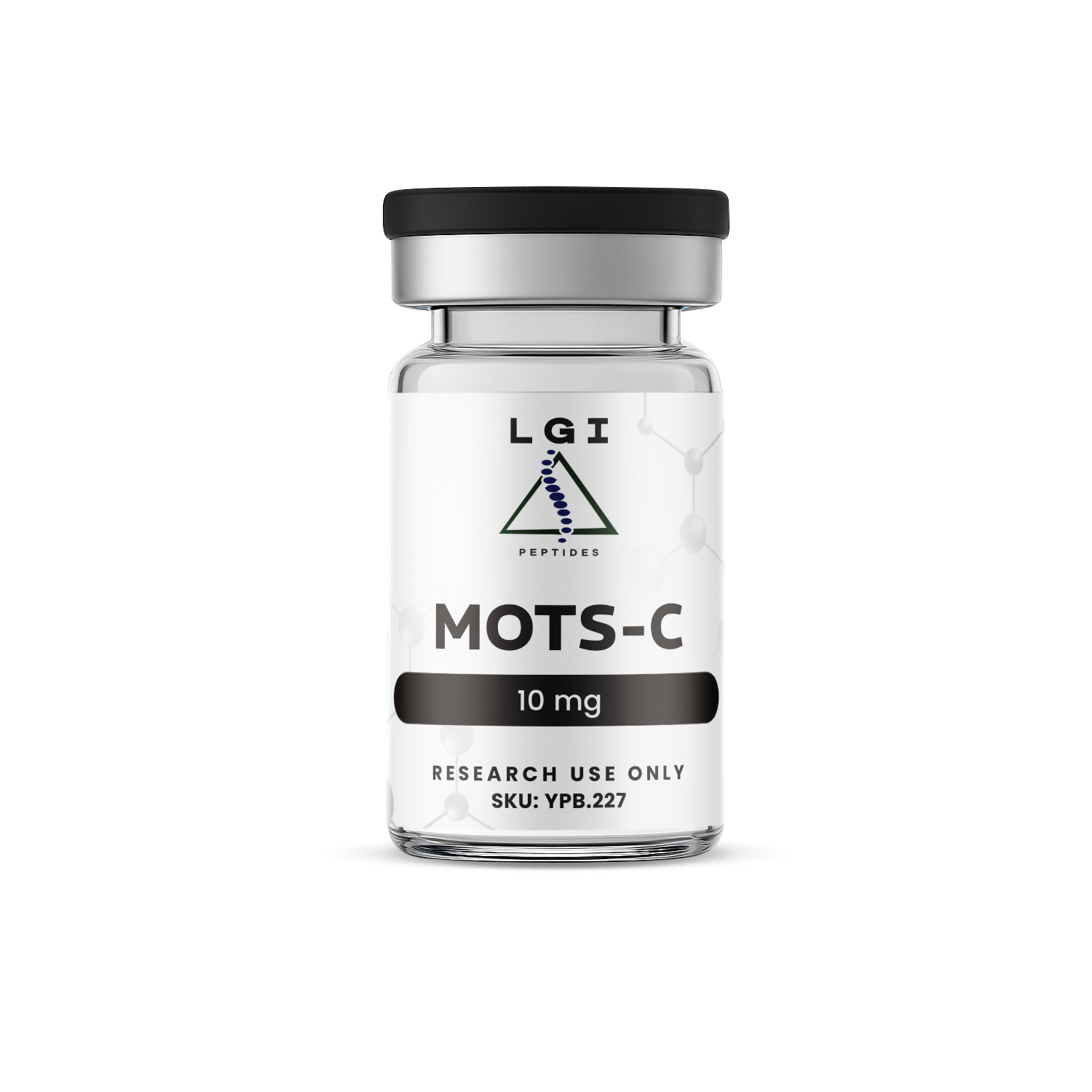
MOTS-c
Price range: $100.00 through $200.00
MOTS-c is a mitochondria-derived peptide encoded within the 12S rRNA region of the mitochondrial genome. Research has focused on its roles in metabolic regulation, insulin sensitivity, exercise adaptation, and AMPK pathway activation — with implications for aging and metabolic disease research.
4 published certificates
Certificate information is temporarily unavailable.
Description
MOTS-c — often referred to in research circles as "exercise in a bottle" — is a mitochondria-derived peptide encoded within the 12S rRNA region of the mitochondrial genome. It earned this remarkable nickname because studies have demonstrated that MOTS-c mimics many of the key metabolic adaptations that the body undergoes during physical exercise, even in the absence of activity itself.
The reason MOTS-c produces exercise-like effects lies in its ability to activate AMPK (AMP-activated protein kinase), the master metabolic sensor of the cell. When AMPK is activated — as it is during exercise — it triggers a cascade of beneficial metabolic responses: enhanced glucose uptake into muscle cells, increased fatty acid oxidation for energy, improved mitochondrial biogenesis, and greater insulin sensitivity. MOTS-c has been shown to translocate from the mitochondria to the nucleus under metabolic stress, where it directly regulates gene expression related to energy metabolism and stress response.
Research has further demonstrated that MOTS-c levels naturally decline with age, paralleling the well-documented reduction in metabolic efficiency and exercise capacity seen in aging populations. By restoring MOTS-c signaling, studies in animal models have observed improvements in physical endurance, body composition, glucose homeostasis, and protection against diet-induced obesity — all hallmarks of what regular exercise provides to the human body.Not for human use.
Documentation & Quality Assurance
Each lot is sourced through our verified global supply chain with emphasis on traceability and quality control.These documents are reviewed internally and displayed as they become available.
Important Notice
This product is intended for laboratory research use only. It is not intended for human or veterinary use, and must not be used for diagnostic, therapeutic, or clinical purposes.
This material is not a drug, medical device, or dietary supplement, and has not been evaluated by the U.S. Food and Drug Administration.
Quality & Manufacturing
We work directly with the manufacturers. Each supplier is reviewed for reliability, documentation integrity, and transparency in testing.
Our minimum purity standard is 98%. Every batch we ship has its own certificate of analysis, and every certificate confirms identity, purity and net content. Where available, endotoxin testing results are included on Certificates of Analysis to verify laboratory purity; their inclusion is for research quality assessment only and does not imply suitability for human or veterinary use.
All research materials are sealed for integrity and packaged for stability during storage and transport from manufacturing through final delivery.
Molecular Specifications
CAS Number
1627580-64-6
Molecular Formula
C₁₀₁H₁₈₀N₃₄O₂₉
Molecular Weight
2174.75 g/mol
Physical Form
Lyophilized powder
Storage
−20°C long-term; 2–8°C short-term
Appearance
White powder
Solubility
Soluble in sterile water
Amino Acid Sequence
Tyr-Arg-Trp-Leu-Thr-Ile-Ser-Gly-Leu-Leu-Leu-Pro-Pro-Ile-Leu-Leu-Leu-Ser-Pro-Leu-Ile-Leu-Leu-Leu-Leu-Pro-Pro-Ile-Leu-Leu-…
Chain length: 16 amino acids
Peer-Reviewed Research
The following peer-reviewed publications represent key research on MOTS-c conducted in laboratory and preclinical settings.
All products sold by LGI Peptides are strictly for research use only and are not intended for human consumption or therapeutic application.
[1] MOTS-c is a mitochondrial-derived peptide that regulates metabolic homeostasis
Lee C, et al. — Cell Metabolism, 2015
Discovery paper establishing MOTS-c as a mitochondrial-encoded peptide that regulates insulin sensitivity and metabolic homeostasis.
[2] MOTS-c peptide increases physical endurance and muscle performance in mice
Reynolds JC, et al. — Nature Communications, 2021
Demonstrated MOTS-c's enhancement of physical performance and muscle metabolism in preclinical exercise models.
Research Use Only: All products are intended exclusively for in-vitro laboratory research.
They are not approved for human or veterinary use, consumption, or therapeutic application.
Citations are provided for informational purposes and do not constitute medical claims.
Additional information
| Weight | 0.0625 lbs |
|---|---|
| Dosage | 10mg, 40mg |
Certificate of Analysis
Every batch undergoes independent third-party laboratory analysis to verify identity, potency, and safety. Testing includes quantitative assay verification, heavy metals screening, and comprehensive microbial analysis.
All Available COAs
Storage Instructions
All products from LGI peptides are manufactured using a lyophilization (freeze-drying) process. This method is designed to maintain product integrity and allows vials to remain stable during shipping for approximately 3–4 months.
Once a vial is reconstituted with bacteriostatic water, it should be stored in the refrigerator to help maintain stability. Under these conditions, reconstituted material is generally considered stable for up to 30 days.
Lyophilization is a dehydration technique in which compounds are frozen and then exposed to low pressure. This causes the water in the vial to sublimate directly from solid to gas, leaving behind a stable, crystalline white structure. This powder can be kept at room temperature until reconstitution.
Upon receipt, products should be stored away from heat and light. For short-term use, refrigeration at approximately 4°C (39°F) is suitable. For long-term storage (several months to years), vials may be placed in a freezer at approximately -80°C (-112°F). Freezing is the preferred method for preserving product stability over extended periods.
⚠️ Important Notice:
These products are intended for research use only. Not for human consumption.
Related products
-
NAD+
Price range: $200.00 through $300.00Select options This product has multiple variants. The options may be chosen on the product page -
-
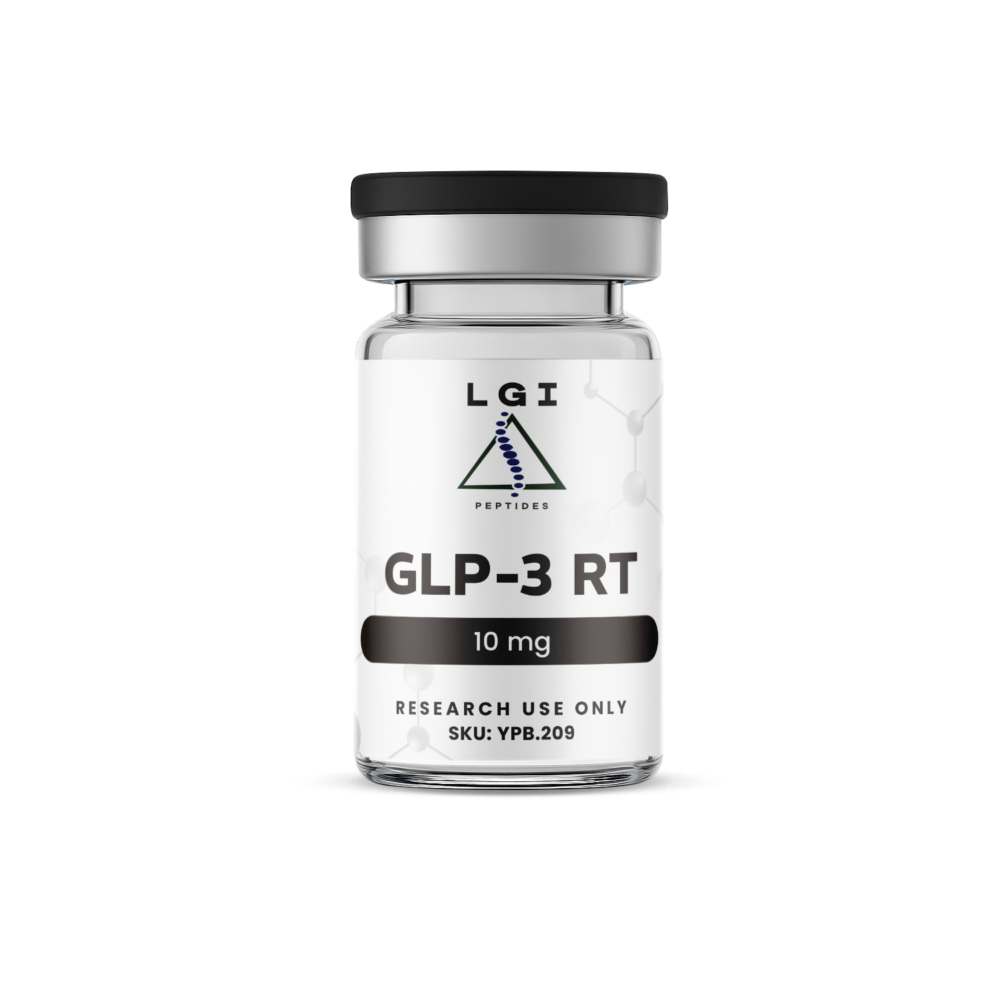
GLP-3 RT
Price range: $220.00 through $540.00Select options This product has multiple variants. The options may be chosen on the product page
Reviews
There are no reviews yet.